
The foreign press have recently picked up on a new ‘craze’ in Japan: cosmetic dentistry for yaeba, or, as I like to call them, fangs.
The above photograph is a very extreme version, but many Japanese people have overlapping or wonky teeth.
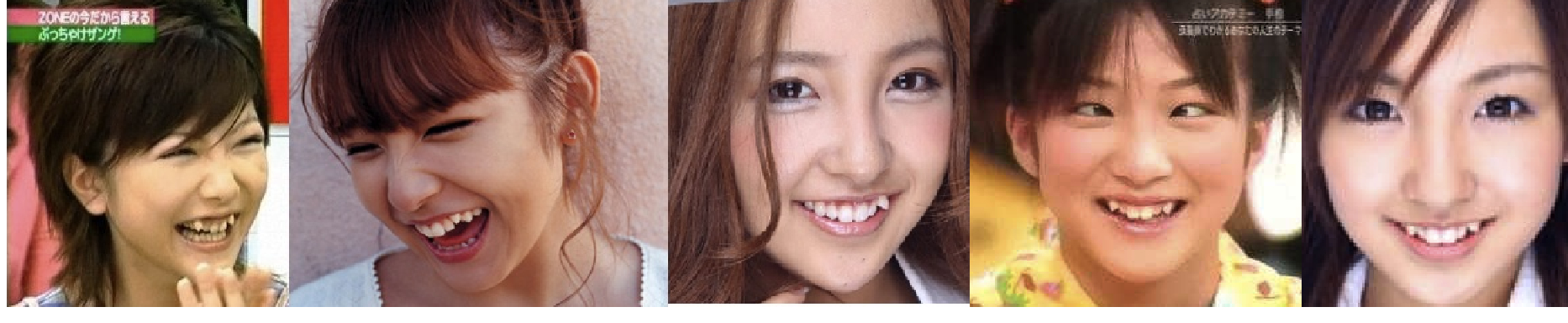
Although it might look like an orthodontic horrorshow to Americans, it’s considered cute to have a couple of yaeba, and some dentists have apparently started services to actually make them rather than correct them. One theory is that being slightly ‘imperfect’ makes girls less intimidating and easier to approach, while this post points out that it feeds into an infantilised sexuality: crowded or jumbled teeth are more common in children, making women with them look younger.
Why do people in Japan have such bad teeth? If you look around in a crowd here, the odds are you’ll see a horrifying variety of gnashers; from fangs to crumbling, yellow and brown incisors, enormous overbites, and some so jumbled they look like a handful of popcorn. I once taught a student who appeared to have two rows of teeth, with some literally protruding from their palate.
It’s not just aesthetic concerns that make overcrowded mouths a worry, however. A wonky line of teeth is difficult to clean, and much more susceptible to decay— many of the ‘hidden’ front teeth I see in Japan are yellow or brown. Tooth decay has been linked to dementia, heart disease, pneumonia and “poor pregnancy outcomes”, not to mention general infections that can be lethal without treatment.
Modern dentistry tells us that dental health is all a matter of brushing, restricting sugar intake, and calcium. When you think about it, however, this makes little sense. OralB and Colgate haven’t yet reached all 7 billion souls on the planet, and yet many indigenous—and, yes, impoverished—people have perfectly white, straight teeth. So what gives? Why do people who brush thrice daily and drink milk have worse teeth than those who do little other than floss with twigs, while living off carb-heavy diets and often no dairy?
The answer is that in comparison to people eating traditional diets, those consuming ‘modern’ diets in industrialized nations actually bear the epigenetic effects of poor nutrition: small, narrow skulls and dental arches that cramp their teeth. A lack of sufficient vitamins and minerals (namely D, A, calcium, magnesium, iron and zinc) leads to mineral starvation, which in turn causes inadequate bone formation. This can happen in just one generation, but its deleterious effects can also be passed from inadequately nourished parents to their children.
One would think that wealthy people with an access to a variety of foods would be better nourished than, say, a hunter-gatherer community living hand to mouth. Yet there is evidence that our teeth and health in general took a turn for the worst with the advent of agriculture. Farming may have created crop stores that freed people from a subsistence lifestyle, leading to a division of labour that allowed for the development of government, philosophy, architecture and the arts… but we paid for it with our teeth.
Agricultural crops— grains, beans, legumes and nuts— are not only nutritionally inferior to most of the animal or plant foods that constitute hunter-gatherer diets, they also contain anti-nutrients in the form of phytic acid, which inhibits the uptake of minerals such as calcium, magnesium, iron, phosphorus and zinc.
Fortunately for our ancestors, an enzyme called phytase that neutralises phytic acid is present wherever phytic acid is. Careful preparation— such as soaking, fermentation or grinding/milling— can increase the amount of phytase and thereby reduce phytic acid and its damaging effects. Unfortunately, however, most people don’t bother with these traditional techniques any more and tend to eat their nuts raw, their rice and bread brown, and their legumes unsoaked. Modern vegans and vegetarians, who tend to eat more of these foods than omnivores, are particularly at risk of not absorbing the minerals and vitamins they eat as a result.
Phytic acid means that, contrary to the prevailing wisdom, wholegrains are not actually better for you, as the acid is concentrated in the fibrous husk. Apart from taste, this is possibly the reason that traditional cultures began to mill or grind their grains. Traditional diets are generally sound because they are based on the accrued knowledge of generations and observations of the cause and effect of diet. (This is why no society or culture has ever been vegan by choice).
Despite that, populations who depend on agricultural crops for the bulk of their diet tend to have smaller skulls and inferior bone structure to peoples that live off wild food.
This document clearly shows this with skulls found in Fukuoka dating back to Japan’s Jomon period (hunter-gatherers) and the Yayoi period (when rice cultivation began):
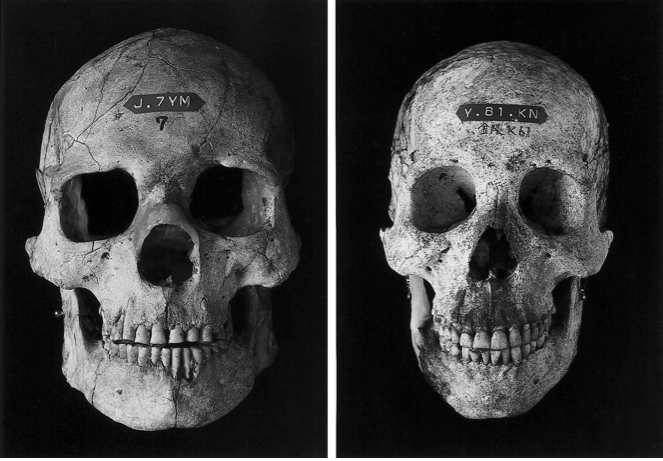
True, the teeth in the Yayoi skull are straight and well-spaced— but it’s noticeably narrower, setting the trend from then on.
Many people assume that the traditional Japanese diet is based around raw fish, rice and vegetables, but this is a fallacy. Even sushi was originally made from fermented fish, and while fishing was no doubt an important part of food culture on the coast, people living inland would have had little access to it. Rice also became the sole staple relatively recently; before that, many ate a mixture of grains, including barley (mugi) and buckwheat (soba), and supplemented this staple with fermented soybeans in the form of miso, natto and soy sauce, and pickled vegetables. Taboos on eating meat came as early as 675 AD thanks to Buddhist beliefs, and the majority of calories came from grains (in 1873, 55% of the daily intake of 1,850 came from rice; in 1960 the average Japanese person ate an astonishing 1000 calories of rice a day, or 120 kilos a year, twice what they do now).
In the West we say “Man cannot live on bread alone.” In Japan, the semi-mystical importance given to rice means that many believe it’s possible to get by without much else. (Disproved by cases of beri-beri in soldiers fed only white rice.) The high value given to rice is probably because its cultivation caused a population explosion and it provided easy calories. But rice is not terribly nutritious. It is superior to wheat in that it is hypo-allergenic (whereas those with celiac disease cannot eat wheat) and it also has less phytic acid. White rice has even less, but lacks the vital B vitamins from the husk. Consuming most of your calories from rice and not enough foods rich in vitamin D, A, K2 and minerals such as calcium, magnesium, iron, phosphorus etc, leaves you wide open to nutritional deficiencies— and yes, bad teeth.
You might ask why this is not common knowledge. I have no idea, particularly when research into the role of diet in dental health was conducted as early as the beginning of the 1900s by Weston A. Price, an American dentist who traveled the globe to find the secret to perfect teeth, and Sir Edward Mellanby, a doctor who uncovered the link between vitamin D and dental/bone health, both of whom had success with diets containing cod liver oil (high in vitamin D and A) in treating dental cavities. Price’s life work took him to Scotland, Australia, Switzerland, New Zealand, Peru, Eskimo tribes in Canada, Amazonian Indians and tribesman in Africa.
The diets varied immensely; from a heavy dependence on dairy in the Swiss village where he started his research— unpasteurized milk, butter, cream and cheese with rye bread, occasional meat, bone broth soups and a few summer vegetables— to the Maasai in Kenya, who subsisted largely on milk, blood and meat, with some vegetables.
Price noticed that when people broke away from their traditional diets and began to eat flour, sugar and other ‘industrialised’ foods, their faces changed. His photographs show this clearly:
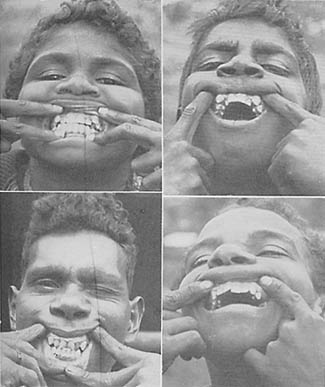
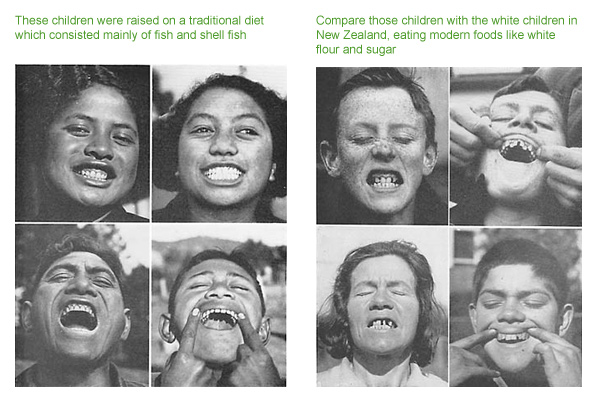
Price argued that modern foods were at the root of most of the West’s nutritional deficiencies and structural bone problems such as narrowed jaws and noses, overbites, lack of cheekbones, pinched nostrils, and weak chins. He attributed modern conditions such as allergies, anemia, asthma, poor vision, lack of coordination and behavioural problems to poor diet.
Although the diets of the people Price visited varied hugely, he postulated the existence of ‘activator X”, now presumed to be vitamin K2, which works synergistically with vitamin D to place calcium where it belongs–in the bones and teeth–and out of the soft tissues, where it does not.
While Price did not realise the importance of phytic acid inhibiting the uptake of minerals, Dr. Mellanby discovered that the rate of cavities in children’s teeth plunged and the rate of healing soared when they stopped eating oatmeal and ate a diet heavy in animal products, potatoes and vegetables instead. Have a look at this for a more detailed explanation of the diet and the mechanisms behind it.
This all means that anyone who has wonky teeth was either malnourished to some extent or had ancestors who were. That yaeba are seen as attractive in Japan therefore bucks biological explanations for the rules of attraction that argue we evaluate partners on their genetic potential to bear healthy children. That said, if you have gone and married Goofy, you could do your children a favour by swopping bread for some nice liver and onions.
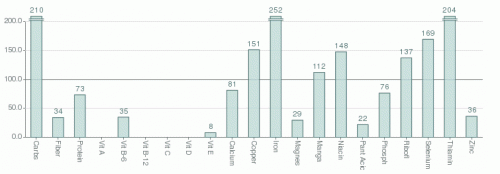

To read more about this, click on the embedded links, or read the two most important articles on phytic acid and Dr. Mellanby’s research into vitamin D, phosphorus and tooth decay reversal.


 Sophie Knight
Leave a reply to Naomi Lisney (@Naomi_in_Tokyo) Cancel reply